
.inc domains Flash Sale! Use INC50 at checkout.
.inc domains Flash Sale! Use INC50 at checkout.

Sophisticated capital does not gamble on ambiguity. In the high-stakes corridors of Sand Hill Road and the boardrooms of the Fortune 500, legitimacy is a binary state. You are either an institutional-grade entity or you are a liability. Professional founders understand that the structural integrity of a company is not a peripheral concern. It is the bedrock of valuation.
By aligning with the Delaware corporate standard and securing a .inc digital identity, you are not merely "launching." You are signaling to the global market that your enterprise is built for permanence, scalability, and defensible IP architecture. This is how you convert brand education time into transaction time.
Most founders treat incorporation like a DMV errand. They fill out the paperwork, pay the filing fees, and move on to the next fire. This is a tactical error that signals a lack of long-term architectural thinking. If you are building a lifestyle business, file in your home state. If you are building a legacy, you go to Delaware.
The Delaware Division of Corporations is not just a government office. It is a specialized operating system for corporate governance. Over 60% of Fortune 500 companies and the vast majority of venture-backed startups run on this code. It is the global standard for one reason: predictability. In a world of volatile markets and shifting regulations, predictability is the ultimate hedge.
Choosing Delaware is the first "institutional" move a founder makes. It tells your future Series A lead that you speak the language of professional capital. It tells the USPTO and your competitors that your IP architecture is housed within a fortress of case law. You are no longer playing house. You are building an enterprise.
Investors do not care about your "creative vibes." They care about how conflicts are resolved when things go sideways. The Delaware Court of Chancery is the only judicial body in the world dedicated solely to corporate law. There are no juries here. You do not leave your company's fate to twelve people who might not understand the nuances of a liquidation preference.
Instead, you get expert judges who have seen every cap table maneuver in the book. This creates a body of case law so deep that most legal disputes are settled before they even reach a courtroom. Lawyers can predict the outcome of a case with surgical precision because the precedents are ironclad.
This predictability reduces your legal friction. It lowers your long-term CAC for capital. When a Tier-1 VC sees a Delaware C-Corp on your term sheet, they check a box and move on to the actual business metrics. If you show up with a Wyoming LLC or a complex offshore structure, you are adding "due diligence drag" to your round. Serious founders eliminate drag.
While the philosophy of Delaware is about institutional signal, the execution is about administrative precision. Follow this 10-step sequence to ensure your foundation is ironclad.
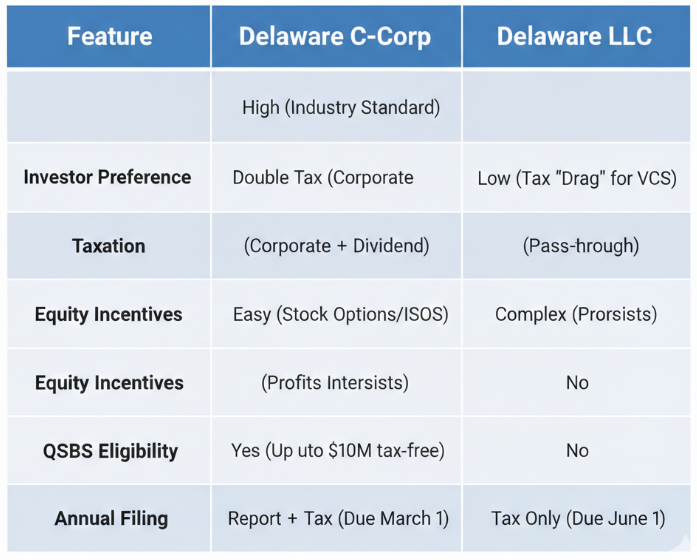
Investors do not just "prefer" C-Corps; their fund structures often require them. Here is how they stack up:
Seasoned legal counsel often highlights that the "Delaware Flip" (converting a local LLC to a Delaware C-Corp) is one of the most expensive ways to fix a cheap mistake. "I have seen founders spend $50,000 in legal fees to correct a structure they set up for $500," notes one Silicon Valley corporate attorney. This is a tax on indecision.
Successful entrepreneurs like those at the helm of modern unicorns treat their legal stack as a product feature. One M7 MBA founder shared that the decision to incorporate in Delaware was less about tax and more about "investor UX." If the paperwork is familiar, the investor focuses on the vision. If the paperwork is exotic, the investor focuses on the risk.
Case studies of Series A rounds demonstrate that a "clean" Delaware cap table accelerates the closing timeline by an average of three weeks. In the world of high-growth tech, three weeks of runway is an eternity. Speed is a byproduct of institutional discipline.
Incorporating in Delaware is the legal foundation. Claiming your .inc domain is the digital manifestation of that foundation. For years, founders settled for "Get[BrandName].com" or "[BrandName]App.io." These are the digital equivalents of renting a desk in a co-working space. They scream "early stage" and "unproven."
A .inc domain is a balance sheet decision. It is an immediate signal of maturity. It tells the market that you are not just a project. You are a corporation. By matching your legal status to your digital identity, you collapse the gap between your brand and your institutional reality.
When you send an email from a .inc address, you aren't fighting for credibility. You are starting from a position of authority. You save hundreds of hours in brand education because the domain does the heavy lifting for you. You can search for your .inc domain today to see if your primary corporate asset is still available.
A Delaware C-Corp is the only structure built for scale. It allows for the easy issuance of stock options to attract FAANG-level talent. It handles complex vesting schedules with ease. Most importantly, it is the only vehicle that qualifies for Section 1202 Qualified Small Business Stock (QSBS) treatment.
Under current US tax law, founders and early employees can potentially exclude up to $10 million in capital gains from federal taxes upon exit. This is not a "nice to have" feature. It is a massive financial lever. If you aren't incorporated as a Delaware C-Corp from the jump, you are leaving millions of dollars in future personal net worth on the table.
Institutional maturity requires more than just a filing. It requires hygiene. You need a Registered Agent in Delaware to act as your physical presence. They are your shield against missed legal notices and service of process. This is not an area to cut costs with a bargain-basement provider.
You must also account for the Delaware Franchise Tax. Amateurs look at the "Authorized Shares" method and panic at a $200,000 tax bill. Professionals use the "Assumed Par Value Capital Method" to bring that number down to the $400 range. This is the difference between reading the manual and understanding the system.
Every dollar spent on your corporate infrastructure should be viewed through the lens of unit economics. If your corporate structure adds $5k to your annual burn but increases your valuation by 5% through "investor readiness," the ROI is astronomical.
The .inc extension isn't just a TLD. It is a global shorthand for "Business." Owning your brand on a .inc domain provides a layer of IP architecture that is harder to challenge. It shows intent. It shows that you have the capital and the foresight to secure your primary brand asset. This is digital real estate that appreciates as your corporate entity grows.
Stop thinking about your domain as a marketing expense. Start thinking about it as a defensive moat. In a world where AI-generated clutter is making trust harder to verify, the signals you send (your legal jurisdiction and your digital identity) are the only things that remain defensible. You can learn more about how this fits into your overall startup branding strategy on our architectural deep-dive series.
The process of incorporating in Delaware is straightforward, but the strategy behind it is complex. You are not just filing papers. You are setting the stage for every negotiation, every hire, and every funding round for the next decade.
The most successful founders I know do not wait for "traction" to act like a corporation. They act like a corporation to get traction. They secure the Delaware filing. They secure the .inc domain. They build the institution before they build the product.
This is the standard. Anything less is just a hobby. If you are ready to stop playing at "startup" and start building a permanent fixture in the market, the path is clear. Secure your legal foundation in Dover. Secure your digital legacy at my.inc.

.webp)
